Our research shows that more than half of consumers are spending less on products and services now than they did a year ago—but they’re not lowering their expectations for great experiences. That raises the stakes for every commerce interaction and exposes where many brands fall short.
To help brands understand how they can pull ahead in a tough market, Deloitte Digital surveyed 550 B2C company leaders and 1,000 consumers, comparing what consumers expect and experience with what brands believe they deliver.¹
The results revealed a clear divide. Most brands believe consumers would rate their online and in-store shopping experiences as good or excellent, but consumers assess those experiences much less positively. In fact, surveyed consumers said brands are falling short across almost all the basics of the B2C commerce experience.
Some organizations are finding ways to bridge the gap. Our analysis identified brands with high commerce maturity and found they outperform low-maturity brands where it matters most: profitability.
The companies pulling ahead—we refer to them as commerce standouts—didn’t rely on a silver bullet. They focused on offering consistently positive commerce experiences driven by a connected set of capabilities: well-executed fundamentals, data-driven personalization and practical applications of AI.
Back to basics
With spending down, are brands keeping up?
Brands today face a modern twist on the law of supply and demand: Fewer consumer dollars create higher demand on every customer relationship and touchpoint. Most brands believe they’re responding to that pressure by improving commerce experiences—but consumers largely disagree.
Across a range of commerce “basics”—from content quality and accurate site search, to in-store experiences and customer service—consumers were far less likely than brands to rate basic commerce capabilities “excellent.”
The disconnect goes deeper than that.
Consumers in 2026 say their experiences have not meaningfully improved in the two years since our last B2C commerce survey in 2024.² And they’re far more likely than brands to say today’s commerce experiences aren’t keeping up with evolving expectations.
More than half of surveyed consumers reported spending less
Nearly 2 in 3 brands were negatively impacted by reduced consumer spending
20X
Consumers are significantly more likely than brands to say commerce experiences aren’t keeping up with their process expectations and preferences
of consumers purchased more from the brand, recommended the brand and/or engaged more with the brand online
to say customers would rate the online commerce experience they provide as excellent
to rate their ability to differentiate the commerce experience as excellent
Data-driven personalization
One size fits none
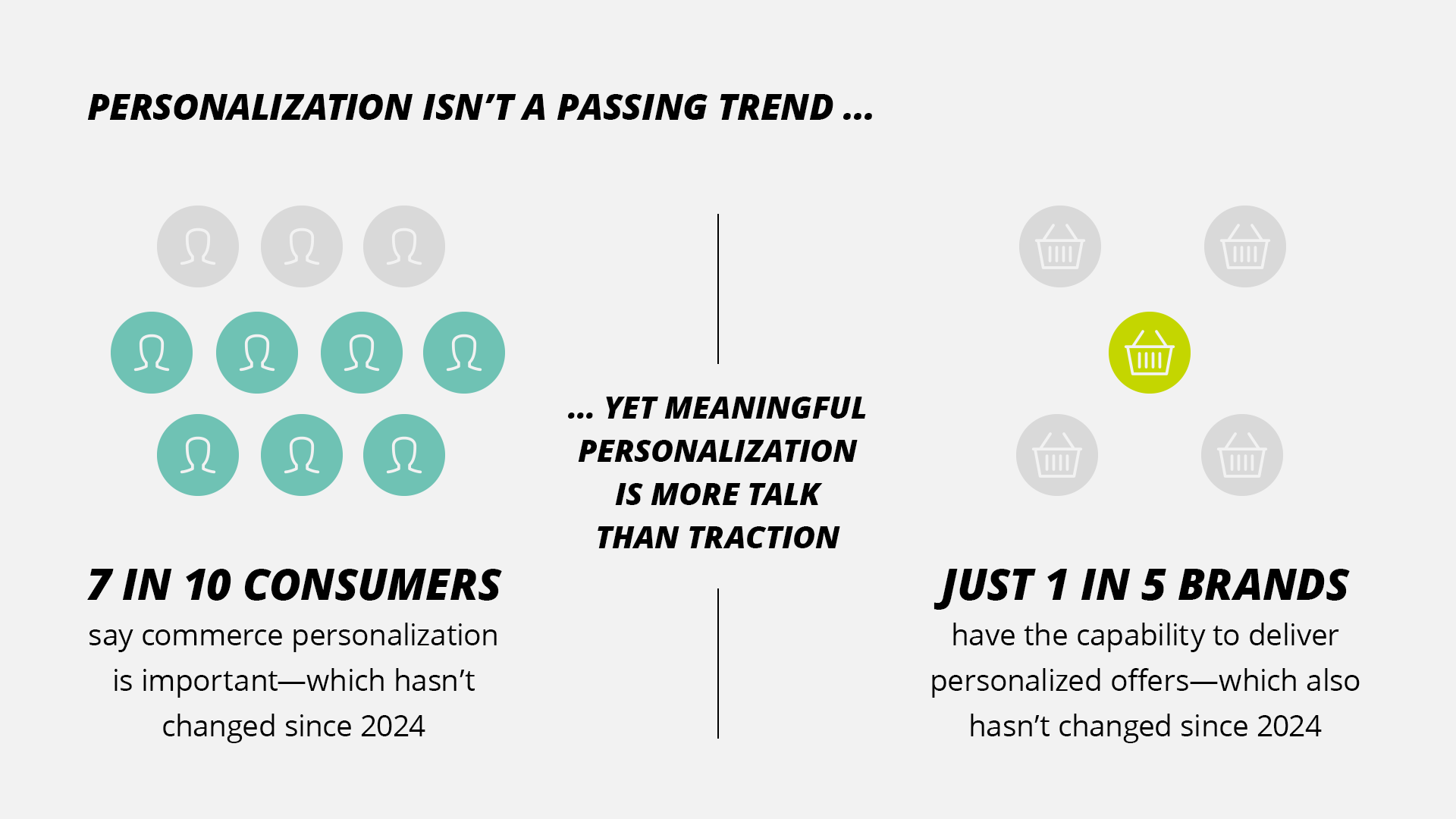
Consumers increasingly expect commerce experiences that feel relevant to them, but many companies aren’t yet able to deliver meaningful personalization.
Brands see the opportunity, ranking personalization among their top three drivers of B2C revenue. And they’re starting to respond. By using data to make search, offers and journeys more relevant, companies can create better commerce experiences and deliver measurable business impact.

1-to-1 is #1
Personalization is the top commerce investment priority in 2026
Top 3 strategic priorities for commerce personalization in 2026:
1. Shopping assistants
2. Online search experience
3. Journey orchestration
already provide personalized site search
already provide personalized offers based on first- and zero-party data and location
AI adoption
Advanced intelligence at work
Brands that have implemented agentic AI see more than operational gains such as improved productivity and efficiency. They’re also beginning to realize benefits at the top line through improved customer retention, revenue growth and customer satisfaction.
Yet extensive adoption of agentic AI remains nascent, with only 12% of companies using agentic AI extensively in commerce. Mature organizations are pulling ahead, but even they remain in the early stages.
This gap represents pure opportunity. Brands that push forward with AI-enabled commerce now can create better consumer experiences that translate to measurable results.
AI is delivering value across the board
Top reported benefits among brands using agentic AI:
How are brands using AI to achieve those benefits?
Most common use cases for agentic AI in commerce:
to use agentic AI extensively
are piloting / testing agentic AI
are using agentic AI on a limited basis
Turning gaps into growth
Outperforming in commerce today requires consistent execution that exceeds customer expectations. Brands have more tools than ever to help them do that, but they need to move beyond experimentation to realize their full benefits. Those that get it right can close the gaps to turn positive experiences into sustained commerce performance.
Are you ready to bridge the divide between consumers’ expectations and the commerce experience you deliver?
ENDNOTES / METHODOLOGY
1. Unless otherwise noted, statistics referenced in this report are based on blind surveys commissioned by Deloitte Digital and conducted by Lawless Research in February and March 2026.
B2C commerce leader survey: Respondents included 550 full-time employees (senior manager level or above) of US business-to-consumer companies with 1,000 or more employees and $100 million or more in annual revenue. Respondents represented consumer lines of business in the following industries: automotive, consumer products, hospitality, media, entertainment and publishing, retail, telecommunications, and travel and transportation.
Consumer survey: Respondents included 1,000 consumers age 18-79 across a representative distribution of generations, genders, race and ethnicity, and household income. Respondents had purchased a product or service online in the past 60 days from a brand in one or more of the following industries: automotive, consumer goods and services, hospitality, media, entertainment and publishing (games, music, movies, TV), retail, telecommunications (internet, phone, wireless), and travel and transportation.
“Commerce standouts” refers to brands in the top quartile of reported capabilities across search and browse, selection and validation, transacting and fulfilling, service and support, and rewards and recognition.
2. Deloitte Digital, “B2C commerce: Consumers deliver brands a reality check,” February 2024, accessed June 5, 2026.
GET IN TOUCH
Bobby Stephens
Principal
Deloitte Consulting LLP
rostephens@deloitte.com
Apurva (AP) Pangam
Principal, Commerce Practice Leader
Deloitte Consulting LLP
apangam@deloitte.com
Simon Chafetz
Senior Manager
Deloitte Consulting LLP
schafetz@deloitte.com