Increasingly, customers are reassessing where, how and why they spend their money. As a result, we estimate approximately $8 trillion in revenue will be up for grabs by 2030. Leaders who sense revenue in motion early and activate the potential for value realization across the front office will define the next era of growth and competitive advantage.
What is revenue in motion, and what does it mean for you?
For decades, sales and revenue shifted gradually for companies, shaped by longer product cycles, adjustments to go-to-market strategies, and long planning horizons. That era is over.
Thanks to smart manufacturing, real-time market insights, global e-commerce and other factors, businesses are making competitive moves faster. That gives customers more choices at their fingertips—and more control in the moment of need.
With more factors impacting consumer purchasing decisions, sales and revenue are increasingly in motion. Incentives designed through annual planning cycles struggle in environments where value shifts daily. Capturing revenue in motion requires different operating models, faster leadership decisions, and clearer accountability in front-office functions.
Three forces of motion drive continuous value migration:
Loyalty is earned moment-by-moment through customer experience and relevance. As switching costs have collapsed, churn has risen.
Fragmented channels, constant notifications and compressed attention spans mean brands face a narrowing window to capture interest, communicate value and convert demand.
Customers demand instant gratification, personalization, seamless self-service across channels, and intelligent, real-time support. That means personalization, speed and consistency have become baseline requirements for brands. In addition, AI is a growing part of the customer experience ecosystem, raising the bar for the quality of experiences that consumers—especially younger and tech-native segments—expect from brands.
Putting challenges in context
Every industry and sector sits at a different intersection of growth and churn—shaping whether leaders must defend, disrupt, expand or optimize. Our revenue in motion heat map highlights four common profiles.
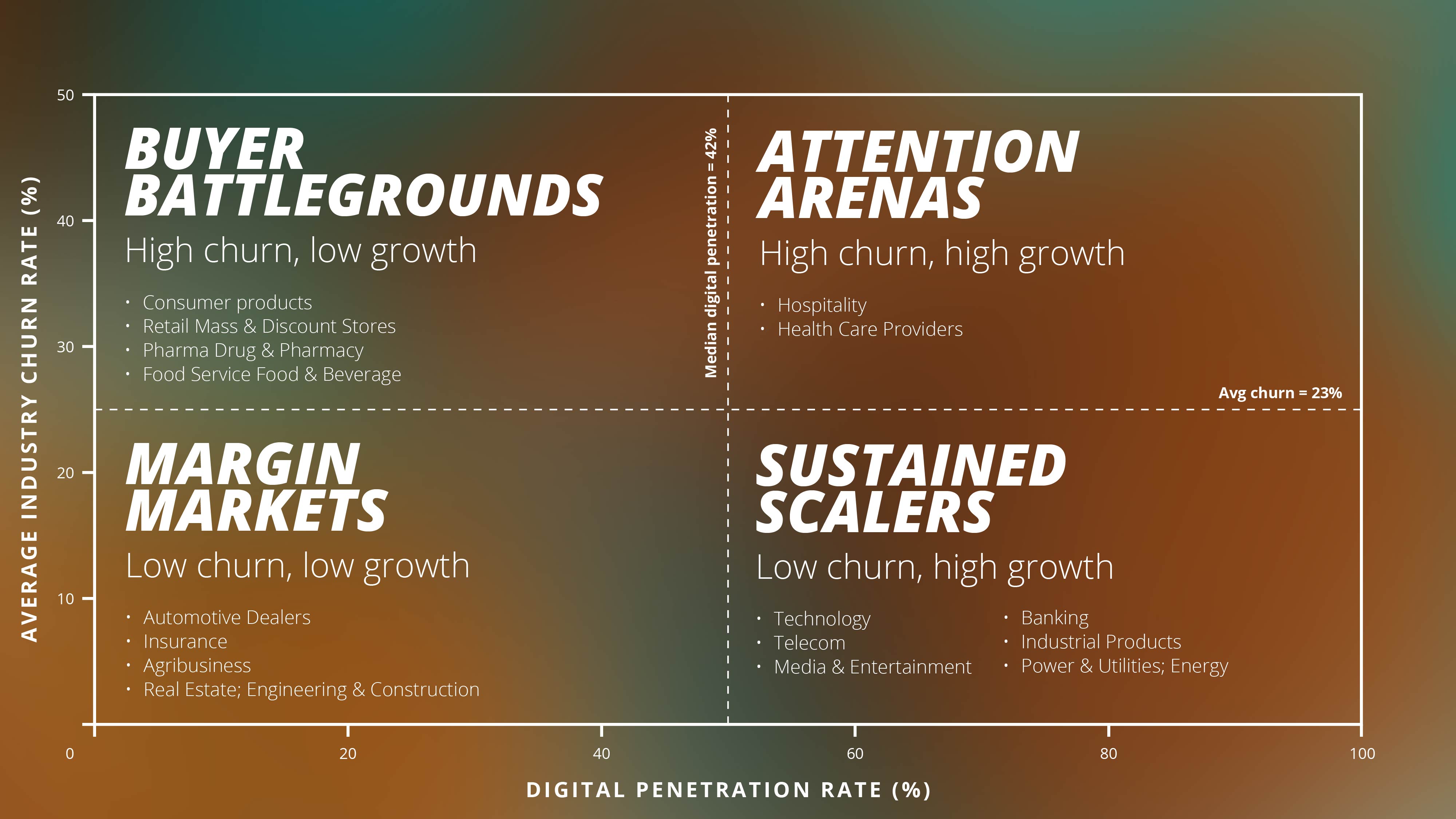
Click here to expand the heat map.
This heat map can help you recognize how revenue is shifting for your business, become more adaptive, and create targeted strategies based on your unique challenges and sector trends.
Front-office strategies to capture revenue in motion
The front office has emerged as the decisive arena of competitive advantage. It includes all customer-facing growth domains—marketing, sales, service, and digital and physical experiences—that shape how organizations acquire, develop, retain and monetize customers.
The following five strategic priorities are essential to positioning your organization to capture revenue faster, serve efficiently and compete smarter.
Organizations must use data to deliver personalized experiences that cut through the noise and consistently drive engagement and monetization.
Metrics that matter: Customer lifetime value, conversion, customer acquisition cost
As customers expect speed and simplicity everywhere, the ability to turn intent into action seamlessly is becoming a baseline expectation, not a differentiator.
Metrics that matter: Time to revenue, win rate, conversion
Dynamic, data-driven revenue management and marketing measurement transforms pricing into a strategic asset, not just a lever for volume.
Metrics that matter: Margin, repeat purchase rate, customer lifetime value
Rather than relying on fixed campaigns and annual plans, high-performing organizations operate in short, continuous cycles—using real-time, always-on, AI-driven insights.
Metrics that matter: Sales cycle time, time to market, sales productivity, conversion
In traditional service models, churn is triggered when service is slow or inconsistent. AI-enabled service models integrate data, automation and human expertise to resolve issues faster and personalize interactions in a unified customer experience.
Metrics that matter: Churn, cost to serve, customer retention
A taxonomy for managing and activating measurable value across the front office
Our revenue in motion heat map shows where value is shifting, allowing you to identify your company’s profile and context. The five strategic priorities define how to compete.
One key consideration remains: what to focus on.
Leaders are surrounded by data, dashboards and performance metrics, but often lack a unifying lens that connects growth, margin and cost to inform clear decisions. Our customer value map (CVM) provides that lens.
The CVM provides a clear taxonomy designed to make revenue in motion visible, measurable and actionable across the front office. It also illustrates how each of the five strategic priorities directly translate into enterprise value, linking customer activity to economic outcomes through improvement levers and value drivers.
Finally, it identifies 40 key metrics that have a direct relationship to revenue, cost and profitability. These metrics are actionable by front office teams in the short to medium term and support investment prioritization.
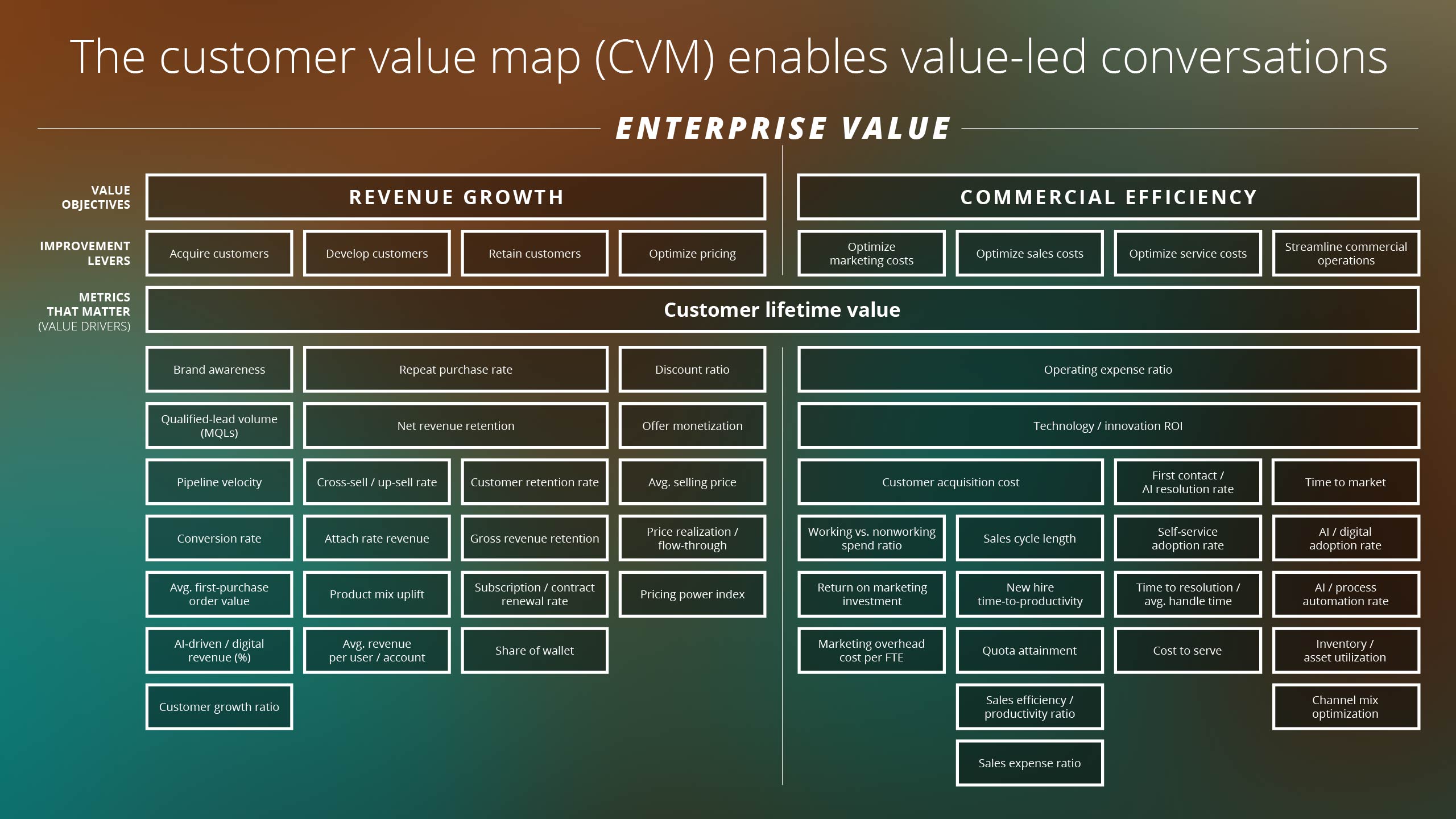
Click here to expand the customer value map.
The CVM is not a prescription. It is a diagnostic and prioritization tool that helps leaders move from ambition to focus. In practice, it enables organizations to take a clear pulse on where performance is strong, where value is leaking, and where investment will have the greatest measurable impact—all based on the company’s heat map profile.
In an economy defined by motion, precision—not size—determines advantage. The CVM can help leaders identify where value is created, lost and won.
About the authors
Pat McCool is a senior manager at Deloitte Digital, where he focuses on commercializing new products, experiences and platforms that drive sustained growth for clients. He has deep experience bringing together Deloitte Digital’s wide range of capabilities across strategy, experience, product, tech and AI to accelerate clients' path to value and innovation in market. While Pat spends most of his time working with financial services clients, he has served clients across many industries including travel, hospitality, retail, consumer products, technology and media. He is passionate about making good ideas real.
Maya Nair is a senior consultant at Deloitte Digital, specializing in customer experience transformation and go-to-market strategy. She uses human-centered design and AI product innovation to drive front-office modernization and revenue growth, including work recognized with a Gold Cannes Lions Award for Creative Business Transformation.
Jonathan Valenti, Maggie Gross and Jon Atkin contributed to this perspective.
SOURCES